
Mountain Bike Sizing Guide (2026) — MTB Size Chart by Height
Quick Answer
Most riders between 5’6″–5’10″ (168–178cm) start on a Medium MTB (17″–18″ seat tube). Between sizes? Smaller = more agile and easier to move around. Larger = more stable with a roomier cockpit. Modern mountain bikes are primarily sized using reach and stack, so check those numbers as well as the size label.
Our main focus is e-bike law and regulation—these sizing guides are maintained as reference resources. Mountain bike sizing has evolved in recent years, with modern geometry focusing on reach and stack instead of just seat tube length.
For the best fit—especially for aggressive riding or if your proportions don’t match standard charts—visit a specialized MTB shop or work with a professional bike fitter.
Information is based on manufacturer sizing charts, current industry geometry data, and ISO 4210 safety requirements. Last reviewed:What Size Mountain Bike Do I Need?
Getting the right mountain bike size makes a noticeable difference in how your bike handles on the trail. A bike that fits you properly will be more comfortable, easier to control, and less tiring to ride. Start with the chart below, then check the specific geometry numbers for the bike you’re considering.
Mountain bike sizing has changed a lot in the past decade. Today’s bikes are designed around reach (horizontal distance from bottom bracket to head tube) and stack (vertical distance). These numbers tell you much more about fit than the old seat tube measurement alone.
Mountain Bike Disciplines & Geometry
Different types of riding need different frame shapes. Here’s what to know:
⚡ Cross-Country (XC)
Geometry: Steeper head angles (68–70°), shorter reach, less travel (80–120mm). Built for climbing and pedaling efficiently. Sizing tip: Standard sizing usually works well here—focus on a comfortable pedaling position.
🌲 Trail / All-Mountain
Geometry: Balanced angles (66–68°), moderate reach, 130–150mm travel. Climbs and descends well. Sizing tip: This is the most common category. Height charts are a good starting point, but consider sizing up if you ride very aggressively.
🏔️ Enduro
Geometry: Slack head angles (64–66°), longer reach, 150–170mm travel. Designed for descending fast while still climbing acceptably. Sizing tip: Modern enduro bikes run long—Medium often fits riders who previously might have chosen Large.
⛰️ Downhill (DH)
Geometry: Very slack angles (62–64°), longest reach, 180–200mm+ travel. Built specifically for downhill riding. Sizing tip: Stability is the priority—many riders prefer the larger size for confidence at speed.
Mountain Bike Size Chart by Height
| Rider Height | Centimeters | Frame Size (in) | Frame Size (cm) | Label |
|---|---|---|---|---|
| 4’10″ – 5’2″ | 148 – 158cm | 13″ – 14″ | 33 – 37cm | XS |
| 5’2″ – 5’6″ | 158 – 168cm | 15″ – 16″ | 38 – 42cm | S |
| 5’6″ – 5’10″ | 168 – 178cm | 17″ – 18″ | 43 – 47cm | M |
| 5’10″ – 6’1″ | 178 – 185cm | 19″ – 20″ | 48 – 52cm | L |
| 6’1″ – 6’4″ | 185 – 193cm | 21″ – 22″ | 53 – 57cm | XL |
| 6’4″ – 6’6″ | 193 – 198cm | 23″ – 24″ | 58 – 61cm | XXL |
These ranges are starting points based on traditional seat tube measurement. Modern bikes vary significantly by brand and discipline—always check reach and stack numbers for your specific model.
How MTB Geometry Has Changed
This is why earlier sizing advice often doesn’t match modern bikes: frames have become longer. A typical 2015 Medium trail bike had about 30–40mm less reach than a 2026 Medium. That difference has a clear effect on how the bike fits and handles.
| Year | XC Reach | Trail Reach | Enduro Reach | What Changed |
|---|---|---|---|---|
| 2015 | 420–435mm | 430–445mm | 440–455mm | Shorter, more upright |
| 2020 | 435–450mm | 450–465mm | 465–480mm | Progressively longer |
| 2026 | 445–460mm | 460–475mm | 475–490mm | Long, low, slack |
This means a 2026 Medium often fits riders who selected Large ten years ago. Always check the actual reach number, not just the printed size label.
Understanding MTB Geometry: Reach, Stack & Standover
Reach: The Number That Matters Most
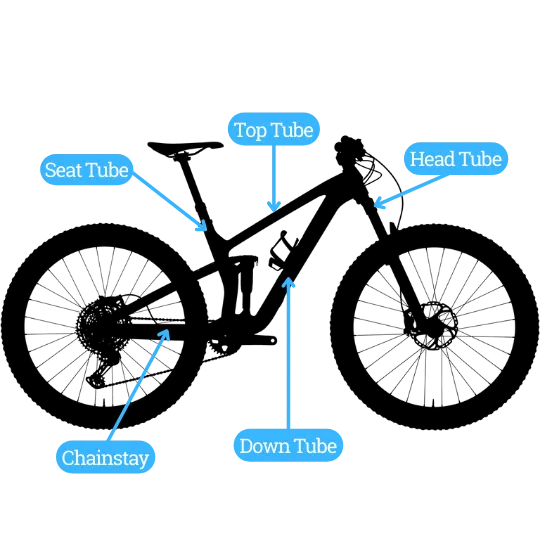
Reach is the horizontal distance from your bottom bracket to the top of the head tube. This indicates how stretched-out you’ll be. A 2015 Medium might have 430mm reach, while a 2026 Medium sits at 460–480mm. That 30–50mm difference meaningfully changes how the bike handles.
How to choose: Shorter reach (430–450mm for M) = more upright, easier to manual, quicker handling. Longer reach (470–490mm for M) = more stable at speed, better on steep terrain, and more planted through rough sections.
Stack: How High Your Cockpit Sits
Stack is the vertical distance from bottom bracket to top of head tube. Higher stack = more upright position. Stack and reach together define your actual riding position much better than seat tube length.
Stack-to-reach ratio: XC bikes tend to have higher ratios (more upright). DH bikes tend to have lower ratios (more forward and aggressive).
Standover: More Important Than Road Bikes
Standover is how high the top tube sits. You need 2–4 inches (5–10cm) of clearance when standing flat-footed over the bike. This matters more for mountain biking because:
- You move off the saddle frequently on technical terrain
- Emergency dismounts happen (avoiding obstacles or catching yourself before a fall)
- Sloping top tubes help, but you still need a margin of clearance
How to measure: Inseam – bike’s standover height = clearance. Aiming for at least 2 inches (5cm), ideally 3–4 inches (7.5–10cm), is a good guideline.
Typical Reach Ranges by Size (2026 Bikes)
| Size | XC Reach | Trail Reach | Enduro Reach |
|---|---|---|---|
| S | 410–430mm | 425–445mm | 440–460mm |
| M | 435–455mm | 450–470mm | 465–485mm |
| L | 460–480mm | 475–495mm | 490–510mm |
| XL | 485–505mm | 500–520mm | 515–535mm |
This highlights why size labels alone are not enough. A Medium trail bike can have similar reach to a Small enduro bike.
Wheel Size & Sizing: 27.5″ vs 29″
Wheel size affects how a frame fits and feels. Most bikes today use 29″ wheels, but some categories and smaller sizes still use 27.5″.
29″ Wheels (Most Common)
Why they’re popular: Roll over obstacles more easily, provide more traction, and hold speed well. Trade-offs: Slightly slower to accelerate and less “playful” for some riders. Sizing note: XS and S frames sometimes can’t fit 29″ wheels without compromising geometry—that’s why many brands use 27.5″ in smaller sizes.
27.5″ Wheels
Why you might choose them: Faster acceleration, easier to move around, and often a better fit on small frames. Trade-offs: Don’t roll over rough terrain quite as easily and may offer slightly less grip. Common on: XS/S frames, some enduro/park bikes, and many bikes for riders under 5’4″ (163cm).
Mullet Setup (29″ front / 27.5″ rear)
Mullet setups are increasingly common on enduro and aggressive trail bikes. You get 29″ rollover and grip up front with 27.5″ maneuverability in back. Standard sizing still applies—focus on reach and stack as usual.
Women’s Mountain Bike Sizing
Women’s-specific MTBs usually have narrower bars (720–760mm vs 780–800mm), different saddles, shorter cranks, and sometimes adjusted suspension tuning. Frames are measured the same way as “unisex” bikes—from bottom bracket center to seat tube top.
The main fit difference: Many women have longer legs and shorter torsos compared to men of the same height. This means reach and stack can matter even more than the basic height chart suggests.
| Rider Height | Centimeters | Frame Size (in) | Frame Size (cm) | Label |
|---|---|---|---|---|
| 4’10″ – 5’2″ | 148 – 158cm | 13″ – 14″ | 33 – 37cm | XS |
| 5’2″ – 5’6″ | 158 – 168cm | 15″ – 16″ | 38 – 42cm | S |
| 5’6″ – 5’9″ | 168 – 175cm | 17″ – 18″ | 43 – 47cm | M |
| 5’9″ – 6’1″ | 175 – 185cm | 19″+ | 48+ | L |
Many women ride “unisex” bikes with component swaps. Focus on reach and stack measurements rather than the “women’s” label—what matters is the geometry matching your body.
🤔 Between Sizes? Here’s How to Decide
Smaller frames are easier to move around, manual, and position in the air. If you spend a lot of time on jumps or at bike parks, the smaller size often feels more manageable and responsive.
Larger frames are more stable at speed and can give more confidence on steep, rough descents. The longer wheelbase tracks more consistently through rock gardens and high-speed sections.
Smaller frames usually climb better—less weight and quicker handling through tight corners and switchbacks. XC racers often prefer the smaller option for direct, responsive steering.
Long torso + short legs → size up and drop the saddle. Short torso + long legs → size down and raise the saddle. Reach is often a better guide than height alone—compare to your current bike’s reach to find a comfortable range.
Common MTB Sizing Mistakes
- ❌ Only looking at seat tube length: Seat tube (the traditional “size”) tells you very little about how a modern MTB fits. Two Medium bikes can have 40mm difference in reach—they will feel completely different.
- ❌ Buying oversized for kids to “grow into”: Kids on bikes that are too big struggle to control them and often lose confidence. It’s usually better to fit them well now and size up later than to start on an oversized frame.
- ❌ Assuming all Mediums are the same: Trek Medium ≠ Specialized Medium ≠ Santa Cruz Medium. Every brand uses different geometry. Always compare reach, stack, and standover numbers.
- ❌ Forgetting about wheel size: 29″ wheels raise the bottom bracket and standover. If you’re 5’2″ on an XS frame, confirm the bike is designed for 29″ wheels in that size—you may need the 27.5″ version.
- ❌ Not accounting for suspension sag: Full-suspension bikes settle 25–30% into their travel when you sit on them. This reduces effective standover height—factor that in when checking clearance.
Manufacturer Sizing Resources
Every brand approaches geometry slightly differently. These links point to their current sizing tools and charts:
Specialized S-Sizing
S-sizing system based on reach with guidance across XC, trail, enduro, and DH bikes.
Specialized S-Sizing →Giant Bicycles
Size recommendation tool and geometry charts for all mountain bike categories.
Giant Sizing Guide →Cannondale Support
Frame geometry and sizing information by model and discipline.
Cannondale Sizing →Santa Cruz Bicycles
Modern long/low/slack geometry with size recommendations by rider height and style.
Santa Cruz Bikes →Canyon Bikes
Direct-to-consumer brand with online sizing tools and geometry comparisons.
Canyon Sizing →Frequently Asked Questions
Should I size up or down for mountain biking?
It depends on your riding style. Size down for playful, technical riding, jumps, and tight trails. Size up for stability at speed, confidence on rough descents, and aggressive downhill riding. Modern long-reach bikes mean many riders fit on the smaller of the two sizes they are considering.
What’s more important: seat tube length or reach?
Reach is generally more important on modern mountain bikes. Seat tube length (the old “size”) mainly affects standover and saddle height range. Reach determines where your hands sit relative to your hips, and has a larger effect on handling and comfort. Prioritize getting the reach in a comfortable range, then fine-tune with saddle height and cockpit components.
Do 29″ wheels fit small riders?
Sometimes. Many brands design XS and some S frames around 27.5″ wheels because fitting 29″ wheels can compromise geometry on very small frames. If you’re under 5’4″ (163cm), check whether the bike in your size is built for 29″ or 27.5″ wheels and review the standover height.
How much standover clearance do I need?
A good guideline is 2–4 inches (5–10cm) of clearance when standing flat-footed over the top tube. Mountain biking involves quick dismounts and moving around the bike on technical trails. On full-suspension bikes, remember the bike sits lower when you’re on it due to suspension sag—sizing charts are designed with this in mind.
Can I adjust a bike if I get the wrong size?
You can adjust details such as stem length (±20mm), handlebar rise, and saddle position. These are intended for fine-tuning. If the frame reach is off by 30mm or more, those adjustments usually can’t fully compensate, and selecting a different frame size is often the better solution.
What size MTB for a 6-foot tall rider?
Most 6-foot (183cm) riders start with Large, but modern long-reach geometry means Medium can also work for some riders. Check the actual reach: around 450–470mm suggests Medium could fit, while 475–490mm suggests Large. Your torso-to-leg ratio and riding style matter—if possible, test both sizes.
Do women’s mountain bikes fit differently?
Women’s bikes use the same geometry measurements but typically have narrower bars, different saddles, and sometimes shorter reach options or tuned suspension. Many riders are comfortable on “unisex” bikes as long as reach and stack are appropriate—fit matters more than the label on the frame.
How does suspension affect bike size?
More suspension travel generally means a longer and taller bike in the same nominal size. A 150mm trail bike will usually be longer and slacker than a 100mm XC bike in the same size. Suspension also compresses about 25–30% when you sit on the bike (sag), which changes ride height and effective standover—brand size charts are created with this in mind.
Standards & References
Mountain bike sizing and design are informed by ISO 4210, which sets safety and performance requirements for bicycles, including mountain bikes. Brands interpret these requirements in different ways, and geometry has changed significantly since around 2015—frames have become longer, slacker, and lower.
Always refer to current geometry charts rather than relying on older sizing advice. A size that worked on a bike built ten years ago may correspond to a different reach and fit on today’s frames.