E-Bike Terminology & Legal Language Explained
Confused by e-bike jargon? This glossary focuses on what riders actually need for compliance and buying decisions—classes, street-legal rules, and the specs that change how an e-bike rides. Definitions are aligned with federal law and the 3-class system adopted by most states. For state-specific rules, follow the links in each definition.
E-Bike Classes & Legal Terms
Class 1 Legal
Pedal-assist only up to 20 mph, max 750W. Widely allowed on bike paths and multi-use trails. Most accepted class for trail access—often your safest choice for mixed-use riding. Class details →
Class 2 Legal
Throttle + pedal-assist up to 20 mph, max 750W. Trail access varies—check your state. Throttle lets you move without pedaling, but some trails restrict throttle-equipped bikes. Learn more →
Class 3 Legal
Pedal-assist up to 28 mph. Often requires speedometer and helmet; trail access limited in most states. Great for road commuting. Some Class 3 bikes include throttle, but it’s typically limited to 20 mph. Learn more →
Street-Legal
An e-bike that meets federal and state requirements for use on public roads—typically 750W max, proper class labeling, and speed limits. Street-legal basics → Check your state →
Cut-Off Speed
The speed where motor assistance stops automatically (20 mph for Class 1/2, 28 mph for Class 3). You can always pedal faster—the motor just won’t help past that point.
Manufacturer Label
Sticker indicating class, max assisted speed, and motor wattage—required in most class-law states. Check your frame or battery housing. No label? Some states treat unlabeled e-bikes as unclassified motor vehicles.
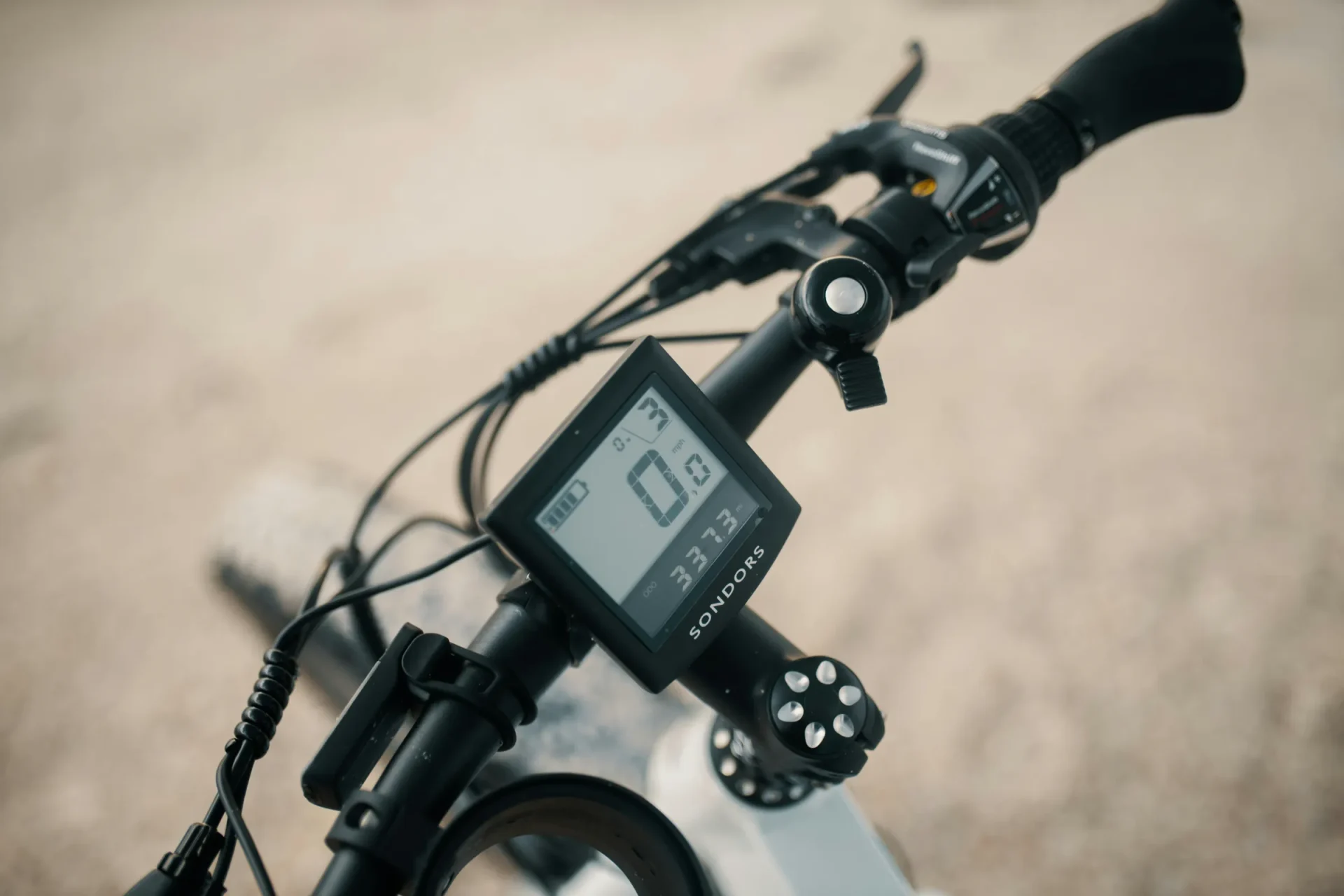
Speedometer
Required on Class 3 e-bikes in many states. Confirms you’re within the 28 mph assisted limit. Most e-bike displays include this.
Helmet Laws
Vary by state and class. Class 3 riders and those under specific ages are often required to wear helmets. See your state →
⚠️ Common Misconception: “750W is the federal limit”
Technically, federal law says “less than 750 watts”—but states commonly use “750W or less” in their class definitions. In practice, 750W motors are universally accepted. Motors over 750W may be classified as mopeds or motor vehicles.
Motors, Assist & Controls
Pedal Assist (PAS)
Motor provides power only when you’re pedaling. Multiple levels (Eco → Turbo) let you choose how much help you get. Higher assist = more power, but shorter range. Eco mode can double your miles.
Throttle
Delivers motor power without pedaling (Class 2). Thumb lever or twist grip. Useful for starting from stops or resting your legs. On Class 3 bikes with throttle, it’s typically limited to 20 mph even though pedal-assist goes to 28.
Walk Mode
Low-speed assist (~4 mph) to push a heavy e-bike uphill, through crowds, or across parking lots. Activated by holding a button on the display or controls.
Torque Sensor
Measures how hard you push the pedals and delivers proportional assistance. Creates a natural, intuitive riding feel. Found on premium bikes. Feels like a tailwind that matches your effort—push harder on hills, get more help.
Cadence Sensor
Detects whether your pedals are rotating and triggers a set level of assist. Simpler, more affordable, but less responsive than torque sensing. Power is steady regardless of how hard you pedal. Can feel “all or nothing” compared to torque.
Mid-Drive Motor
Motor mounted at the crank/pedals. Uses the bike’s gears for efficiency, especially on hills. Balanced weight distribution. Preferred for trails and varied terrain. More expensive but better climbing performance.
Hub Motor
Motor built into the front or rear wheel hub. Simpler, quieter, more affordable. Great for flat commutes. Rear hub is more common. Front hub can feel odd in handling. Neither uses the bike’s gears.
Regenerative Braking
Recovers a small amount of energy during braking—typically 5-10% range extension. Found mainly on direct-drive hub motors. Nice to have, but don’t buy a bike for this feature alone. Real-world gains are modest.
Controller
The e-bike’s “brain” that manages power flow from battery to motor based on your PAS level, throttle input, and sensor data.
Battery & Range
Watt-Hours (Wh) Key Spec
Total battery energy capacity. Calculate it: Volts × Amp-hours = Wh. Higher Wh = longer range. Example: 48V × 14Ah = 672Wh. Compare Wh across bikes—it’s the best apples-to-apples range indicator.
Amp-Hours (Ah)
Battery capacity at a given voltage. Higher Ah = longer runtime. But only compare Ah between batteries of the same voltage.
Voltage (V)
Common systems: 36V, 48V, 52V. Higher voltage can deliver power more efficiently, especially under load (hills, acceleration).
Battery Management System (BMS)
Safety circuitry built into the battery. Protects against overcharging, over-discharging, overheating, and cell imbalance. Essential for longevity and safety.
UL 2849 Safety
Safety certification for e-bike electrical systems (battery, charger, motor). Indicates third-party testing for fire and electrical hazards. Look for UL certification when buying—especially important after high-profile battery fire incidents.
Range
How far you can ride on a single charge. Typical: 25–60 miles depending on Wh, assist level, terrain, rider weight, wind, and temperature. Manufacturer claims are optimistic. Expect 20-30% less in real conditions—cold weather and hills hit hardest.
Rider Lingo & Bike Types
Ghost Pedaling
Pedaling lightly just to keep the motor engaged while it does most of the work. Common on flat commutes or when you need a break.
Range Anxiety
Worry about running out of battery before reaching your destination. Reduce it with realistic range estimates, right-sized Wh, and knowing your route’s charging options.
Cargo E-Bike
Built for hauling kids, groceries, or gear. Features: higher payload capacity, longer wheelbase, powerful brakes, and often mid-drive motors. Popular for car replacement. Weight can exceed 70 lbs—check if you can lift it.
eMTB (Electric Mountain Bike)
E-bike designed for off-road trails. Full suspension, knobby tires, mid-drive motor, and geometry built for technical terrain. Trail access varies—most public lands restrict to Class 1 or prohibit e-bikes entirely. Federal lands guide →
Step-Through Frame
Low or absent top tube for easy mounting/dismounting. Popular for commuters, riders with limited mobility, or anyone who doesn’t want to swing a leg over.
Understanding Legal Language
Laws use specific terms. Here’s what they actually mean for riders.
Nominal vs Peak Power
Nominal = continuous rated power. Peak = brief maximum output. Laws reference nominal power—a 750W nominal motor may briefly peak at 1000W+ and still be street-legal. See your state →
Operable Pedals
Federal law requires e-bikes to have fully functional pedals—you must be able to propel the bike by pedaling. This distinguishes e-bikes from electric motorcycles and mopeds. Street-legal basics →
Low-Speed Electric Bicycle
The federal definition: two or three wheels, fully operable pedals, electric motor under 750W, and max speed under 20 mph on motor alone. States add class systems and their own rules on top of this. Class system →
De-Restriction
Removing or bypassing the speed limiter to unlock higher motor-assisted speeds. This voids your street-legal status—de-restricted bikes may be classified as motor vehicles requiring registration, insurance, and licensing.
⚠️ Common Misconception: “Class 3 means throttle to 28 mph”
No. Class 3 is pedal-assist only up to 28 mph. Some Class 3 bikes include a throttle, but it’s typically restricted to 20 mph. If your throttle alone pushes you past 20 mph, you may not meet the Class 3 definition in your state.
Quick Reference
U.S. Speed Limits
• Class 1: 20 mph (pedal-assist)
• Class 2: 20 mph (throttle + PAS)
• Class 3: 28 mph (pedal-assist)
Power Limits
• Federal USA: <750W nominal
• Most states: 750W max
• EU/UK: 250W, 25 km/h (~15.5 mph)
Key Equipment
• Class label/sticker (required)
• Speedometer (Class 3)
• Lights/reflectors (varies by state)
• UL 2849 certification (recommended)
Next: Check Your State’s E-Bike Laws
Terminology is step one. Now see how your state applies it.